California homebuyers are compromising on price, neighborhood

Posted by Rick Griffin on Dec 14, 2018 4:41:34 PM

Housing costsThe California Association of REALTORS® (C.A.R.) recently conducted a consumer survey of California homebuyers. The survey examined the attitudes and behaviors of real estate consumers. According to its 2018 State of the California Consumer Survey, California’s competitive housing market and low housing affordability are forcing homebuyers to make compromises in their home purchases including price, size, location, and school quality.

The survey revealed that 44 percent of buyers bought a more expensive home than they wanted, 33 percent purchased a smaller home than desired, 36 percent purchased a home further from school or work than wished, and 30 percent purchased in an area where schools were of lesser quality.

“Well-qualified homebuyers understand that buying a home can be challenging in a competitive housing market environment and they may not be able to buy the ideal home they want,” said 2019 C.A.R. President Jared Martin. “Instead of finding a home that’s a perfect fit, they are finding a home that’s a good enough fit.”

Buying Experience

Buyers were not deterred by higher home prices and tight housing supply conditions but waited until their financial situations improved or to save for a down payment. Buyers typically saved for five years, and nearly a quarter of those who purchased a home priced $1 million or higher saved more than 10 years.

The source of down payment for the majority of home buyers was their personal savings. Boomers were more likely to use the proceeds from the sale of a previous home since many were repeat buyers. Millennials were significantly more likely than Gen Xers or boomers to use funds received from parents or family or a gift.

California’s costly home prices gave nearly one in three home buyers cause to consider purchasing in another state, but buyers ultimately stayed because they liked the city or state they currently lived in or because of their job, family, or friends. Younger buyers and first-time buyers were more likely to consider leaving the state. With the state’s housing prices at 161 percent above the national average, California’s high housing costs are the biggest factor hurting young, middle-class, often minority families.

Buyers typically spent eight weeks on their home search, and nearly one in three spent 13 weeks or more. Reflecting the extremely tight housing market in the San Francisco Bay area, buyers in the Bay Area spent a median of 10 weeks in their home search. Buyers who bought homes $1 million or higher spent a median of seven weeks searching for a home, while those whose homes cost less than a $1 million spent a median of eight weeks. Generally, the more competitive the housing market is, the longer it takes to find a home.

Buyers made a median of three offers on other homes before having an offer accepted, but nearly one-fourth made more than 10 offers. Those who purchased a home for more than $1 million made five offers on other homes. The hyper-competitive, supply-constrained Bay Area had the highest incidence of multiple offers.

Buyers Preferences

Homebuyers’ preferences varied by age/generation, income, and home buyer status (first-time, repeat, investment buyer, etc.).

The typical first-time buyer purchased a three-bedroom, 1,500-square-foot, single-family home. Nearly half purchased a home in the suburbs, and two-thirds purchased a one-story home. Buying a home within their price range and with the desired number of bedrooms were the top requirements for first-time buyers. They selected their neighborhood primarily based on their budget (53 percent), safety (51 percent), and proximity to jobs/school (38 percent). First-time buyers were likely to purchase a home close to where they previously lived, with only 20 percent choosing to leave the county or state.

Being in a better financial situation, repeat buyers typically purchased a larger home with three bedrooms and a median square footage of 1,700. Three in four purchased a single-family home, and more than half purchased a one-story home. Nearly half bought a home in the suburbs, 26 percent bought a home in the city outside of downtown, 18 percent bought homes downtown, and 11 percent bought in a rural area.

With lower income and less equity under their belts, millennials tended to buy smaller, more affordable homes than older generations with a median of 1,500 square feet and a median price of $350,000. Millennials were more likely to purchase a condominium or townhome in a suburb (43 percent), followed by a home in the city outside of downtown (26 percent). They selected the neighborhood they wanted to live in based on their budget (52 percent), safety (49 percent), proximity to jobs/schools (40 percent) and family/friends (33 percent).

Similar to millennials, the Gen X group most commonly selected a home in the suburbs, trading up to a home a median of 300 square feet greater than that of their previous home. More than half of them selected a home with at least one bedroom larger than their previous residence. Most purchased a single-family home, and townhouses/condos accounted for nearly 20 percent of those purchased. The majority of Gen Xers chose to buy within the same county as they previously lived, presumably to minimize disruption from the relocation and maintain the same lifestyle.

Boomers were most likely to have purchased a single-family home in the suburbs without stairs and were also the most likely to buy a home in a rural area since many of them are approaching retirement age and planning to age in their home and seek a quieter lifestyle. They were less likely to purchase in the same county they previously resided in with 24 percent buying in another county perhaps to be closer to children/grandchildren or healthcare facilities.

C.A.R.’s 2018 State of the California Consumer Survey , conducted online between May 9 and July 9, 2018, was designed to understand the process of home buying and selling, as well as the motivation behind renting and owning from the perspective of the California consumer. Surveys were sent to 470,803 consumers ages 18 and older in the state of California, resulting in 6,144 participants, a 1.3 percent response rate. The margin of error was plus-or-minus 1.2 percent at a 95 percent confidence interval. For the buyers section, 1,441 buyers purchased a home in California within 18 months preceding survey participation.

Topics: Market Information, Industry

Former PSAR President Joined Association at Age 19

Posted by Rick Griffin on Dec 7, 2018 3:58:04 PM

Wayne Ansley collage

This article is the latest in a series highlighting former PSAR presidents.

It was 1973. As a teenager growing up in Chula Vista, Wayne Ansley had long hair, a ponytail and played guitar and keyboard in a rock band. But, then, he realized he had to get a real job. His father Bill, a retired U.S. Army lieutenant colonel, was a real estate broker at the time and encouraged his son to get his real estate sales license.

“After I graduated from Anthony’s Real Estate School and received my sales license, my dad gave me $500 to go buy some business suits,” said Wayne. “Then, I joined what was then called the South San Diego Bay Cities Association of Realtors, which later became PSAR (in 1992). I was 19 years old, and I think I was the youngest member ever to have joined the Association, until someone who was 18 years old joined later.

“My first real estate deal in 1973 was selling a home on Agua Tibia Street in Chula Vista for $22,000. The sellers, an elderly couple, the Papes, took pity on me and trusted a young, new agent. On those days, the sales contract was a one-page, legal-size form and copies were made with carbon paper. Cell phones weren’t invented yet. If you had a pager, you were a hot-shot like a doctor.”

After his father Bill passed away at age 61 in 1983, and Wayne got his broker’s license and took over the family business. In 1991, he joined the PSAR board of directors. He also became a California Association of REALTORS® (C.A.R.) Director in 1992, and attended many C.A.R. state conventions on behalf of PSAR. In the 1990s, Wayne served on many PSAR committees, including Community Relations, Grievance, Professional Standards, Government and Political Affairs and Building Operations. For two years, in 1994 and 1995, Wayne served as board VP. In 1996, he was elected as president-elect. In 1997, he served as president of PSAR.

As a member of the PSAR Building Committee in 1992, Wayne played a role in the relocation of the PSAR offices in Chula Vista from “L” Street to PSAR’s current headquarters, a 16,467-square-foot building at 880 Canarios Court.

Wayne estimates he has sold more than $100 million of property over his 45-year career. He remains today an active full-time broker. His diversified background in real estate has included residential sales, investment properties (including commercial, apartment and industrial sales and leasing), foreclosure short sales and full-service property management. He also has developed and built several apartment buildings, houses and a condo project.

“While previewing or showing properties, I have set-off alarms, broken keys in locksets, accidentally let out dogs and cats and, one time, walked into a master bedroom where a naked lady was in the shower. She screamed at the top of her lungs,” said Wayne.

“As a young agent, I had a string of bad luck with several unreliable cars. I had a Mercury Capri sports car with a broken passenger seat that was propped up with a piece of wood. I picked up a buyer from Japan who had a camera hung around his neck. I hit a bump in the road and the piece of wood came loose and the buyer went flat on his back and got hit in the head by his camera.

“Then, I bought a Ford Pinto for $300. I was showing property to a Naval officer wearing his dress whites uniform. On the freeway, the front end started shaking at 40 miles per hour and then rusty water from the heater leaked on his white pants. He actually bought the house I showed him and later he told me, `Wayne, the first thing I want you to do with your commission check is to go buy a new car.’”

Over the years, Wayne said his other cars have included an Oldsmobile Delta 88 and a Cadillac Sedan Deville. He then purchased his dream car, a BMW 740 I-L.

Wayne is especially proud of his contributions as a member of the Pilgrim Lutheran Church. As a volunteer, he donated more than 3,000 hours over the past year-and-a-half and helped the church sell its previous three-acre property at 497 “E” St. for $5.5 million (escrow closed in August). The church has since merged with their sister church located on a larger 8.5-acre site at 810 Buena Vista Way to become the Victory Lutheran Church and Christian Academy. “It was the most difficult transaction I ever had, but also the most gratifying because I was able to give back to the Lord in gratitude of 45 years of success,” he said. Construction recently began on their new church project.

Topics: Leadership, Industry

2018 YPN Leadership Luncheon

Posted by Joyce Evans on Dec 4, 2018 4:32:16 PM

ornaments

You are invited to join us. 

As we quickly approach the end of a successful year, the PSAR YPN would personally like to invite you to  join them for lunch as they look for new leadership and pay homage to this year’s sponsors and the current board.

Thursday, December 13, 2018
12:00 PM - 1:30 PM
Eastlake Country Club, 2375 Clubhouse Dr., Chula Vista, CA 91915

Special Thanks to our YPN 2018 Sponsors
Ted Przybylek with Rancho Ted and Zoe Khetani with Navy Federal Credit Union

     CLICK HERE TO RSVP     

Special Guest Speaker Eric Wu, Incoming C.A.R. YPN Chair will speak on “Why YPN?”

Lunch is on us! We will all eat, drink and be merry as we look back on the past year’s accomplishments, take a look at what is in store for 2019 and thank our dedicated sponsors for their support.

Important: If you are interested in joining the YPN Leadership in 2019 email Sergio Hernandez at sergio@psar.org. Also, please bring anyone you know who is interested in joining the YPN.

Topics: YPN

New PSAR Office in Clairemont will serve housing market

Posted by Rick Griffin on Nov 30, 2018 2:42:51 PM

new PSAR office mapPSAR is proud to announce that a new Service Center in San Diego’s Clairemont community.

The new centrally located PSAR facility, easily accessible throughout central San Diego, at the Liberty Park Plaza, 4340 Genesee Ave., Suite 203, San Diego.  We are right next door Curves on the Second floor.

Clairemont is a vibrant, culturally and ethnically diverse suburb conveniently located for commuters between three freeways, including Interstate 5 and 805 and State Route 52. Its perch atop the mesas of San Clemente Canyon and Tecolote Canyon affords enviable views of Mission Bay and the Pacific Ocean.

The community’s early developers, Lou Burgener and Carlos Tavares, changed the community’s name from Morena Mesa to Clairemont in honor of Tavares’ wife, Claire. In the early 1950s, Clairemont became San Diego’s largest post-war subdivision. Burgener once boasted that between 1952 and 1954 an average of seven tract homes were constructed per day. Clairemont was known at the time as the largest development of its kind in the country. Considered innovative at the time, homebuilders abandoned a more traditional gridded blocks and streets in favor of cul-de-sacs and meandering streets. 

Today, Clairemont offers perhaps the most multicultural dining options in San Diego County. Here you can find international markets, as well as Thai, Italian, South African, Mexican and Lebanese restaurants all within the same block.

The housing markets for Clairemont (92117), Pacific Beach (92109), University City (92122) and Linda Vista (92111) vary greatly for both detached and attached homes. According to recent housing market statistics from industry source HomeDex:

-- The median sales price for a detached single-family home in Clairemont was $729,000 in October 2018, which was 10.3 percent higher than the $660,750 price in October 2017. The October 2018 monthly figure for detached homes in Clairemont was 8.7 percent higher than the year-to-date median sales price of $690,000.

-- In Pacific Beach, the median sales price for a detached single-family home was $1.295 million in October 2018, which was 5.6 percent higher than the $1.226 million in October 2017. The October 2018 monthly figure for detached homes in Pacific Beach was 8.6 percent higher than the year-to-date median sales price of $1.250 million.

-- In University City, the median sales price for a detached single-family home was $922,500 in October 2018, which was 2.7 percent higher than the $898,000 price in October 2017. The October 2018 monthly figure for detached homes in University City was 5.9 percent higher than the year-to-date median sales price of $900,000.

-- In Linda Vista, the median sales price for a detached single-family home was $610,000 in October 2018, which was 3.3 percent lower than the $630,500 price in October 2017. The October 2018 monthly figure for detached homes in Linda Vista was 9.1 percent higher than the year-to-date median sales price of $635,000.

For attached homes, the market also varies greatly among the four communities.

-- For attached homes in Clairemont, the median price was $441,250 in October 2018, which was 6.5 percent higher compared to the $414,500 price the same month a year ago. The October 2018 monthly figure for attached homes in Clairemont was 10.8 percent higher than the year-to-date median sales price of $399,000.

-- For attached homes in Pacific Beach, the median price was $615,000 in October 2018, which was 2.3 percent lower compared to the $629,500 price the same month a year ago. The October 2018 monthly figure for attached homes in Pacific Beach was 0.8 percent higher than the year-to-date median sales price of $620,000.

-- For attached homes in University City, the median price was $485,000 in October 2018, which was 10.7 percent higher compared to the $438,000 price the same month a year ago. The October 2018 monthly figure for attached homes in University City was 8 percent higher than the year-to-date median sales price of $464,250.

-- For attached homes in Linda Vista, the median price was $420,500 in October 2018, which was 7.6 percent lower compared to the $455,000 price the same month a year ago. The October 2018 monthly figure for attached homes in Linda Vista was 4.1 percent higher than the year-to-date median sales price of $433,750.

Homebuyers continue to wait it out, says C.A.R.

Posted by Rick Griffin on Nov 21, 2018 9:34:49 AM

Hosing Market graphs California’s housing market declined for the sixth straight month in October, according to the latest housing market report from the California Association of REALTORS® (C.A.R). C.A.R. also found that existing home sales in the state dropped below the 400,000 level for a third consecutive month. The last time there were three straight months when the sales dipped below 400,000 was February 2015.

Summarizing the overall housing market, mortgage rates remain affordable while demand for existing homes is slowing, home prices are falling slightly, price growth is moderating, price reductions are becoming more common and a tight supply of available homes, still low, is increasing, while many potential buyers are putting their homeownership plans on hold.

In October, C.A.R. said the month’s sales figures was up 3.8 percent from the revised 382,550 level in September and down 7.9 percent compared with home sales in October 2017 of 431,070.

C.A.R. said October’s statewide median home price was $572,000, down 1.2 percent from September ($578,850) and up 4.7 percent from October 2017 ($546,430).

In San Diego County, the median price of a single-family home was $635,500 in October 2018, a slight decrease from the $640,000 price reported for September 2018 and a 13.2 percent decline from October 2017 when the median price was $603,000. San Diego’s year-over-year comparison between October 2018 and October 2017 was the largest decrease among any Southern California market, said C.A.R. Orange, San Bernardino, and San Diego counties all experienced year-over-year, double-digit declines of 11.3 percent, 11.4 percent, and 13.2 percent, respectively. Sales in Los Angeles County declined 5.9 percent and were down 2.9 percent in Riverside County.

Closed escrow sales of existing, single-family detached homes in California totaled a seasonally adjusted annualized rate of 397,060 units in October, according to information collected by C.A.R. from more than 90 local REALTOR® associations and MLSs statewide. The statewide annualized sales figure represents what would be the total number of homes sold during 2018 if sales maintained the October pace throughout the year. It is adjusted to account for seasonal factors that typically influence home sales.

“Homebuyers continued to put their homeownership plans on hold in October and wait out the market,” said 2019 C.A.R. President Jared Martin. “With mortgage rates at seven-year highs making homeownership more expensive and home prices beginning to flatten, this phenomenon will likely continue for the near term as buyers wait for further price adjustments and for interest rates to stabilize.”

“October’s sales decline was not as severe as the double-digit drop experienced in September, but the continued pullback in sales suggests the market will continue to slow and likely soften further into 2019,” said C.A.R. Senior Vice President and Chief Economist Leslie Appleton-Young. “Likewise, as home sales continue to soften, the median price, which was the lowest since March 2018, will also ease up,” said Appleton-Young.

Other key points from C.A.R.’s October 2018 resale housing report included:

  • Homes are taking longer to sell than they did just a few months ago. The median number of days it took to sell a California single-family home rose from 21 days in October 2017 to 26 days in October 2018.
  • Meanwhile, in San Diego County, the median number of days a home remained unsold on the market was 24 days in October 2018, compared to 19 days in both September 2018 and October 2017.
  • Statewide active listings rose for the seventh consecutive month after nearly three straight years of declines, increasing 28 percent from the previous year. October’s listings increase was the largest in four years.
  • Active listings in the $500,000-$750,000 price range experienced the largest year-over-year gain (43.9 percent), followed by homes priced $750,000-$999,999 (40.1 percent). The sub-$200,000 market was the only price segment with a decline of 6.2 percent from last year.

    The unsold inventory index, which is a ratio of inventory over sales, increased year-to-year for the seventh consecutive month in October from 3.0 months in October 2017 to 3.6 months in October 2018. The index measures the number of months it would take to sell the supply of homes on the market at the current sales rate.
  • The 30-year, fixed-mortgage interest rate averaged 4.83 percent in October, up from 3.90 percent in October 2017, according to Freddie Mac. The five-year, adjustable mortgage interest rate also increased in October to an average of 4.08 percent from 3.18 from October 2017.
In other recent real estate and economic news, according to news reports:
  • According to real estate tracker CoreLogic, a chill is settling over the once white-hot Southern California housing market. San Diego home sales decreased 17.5 percent in September 2018. A total of 2,942 homes were sold in the county, down 17.5 percent from 3,568 during the same month the previous year. It was the lowest number of sales for a September in 11 years, compared to September 2007 just before the Great Recession when 2,152 units were sold.
  • CoreLogic also said in September 2018, the median price of a San Diego County home was $575,000, up 7.5 percent from $535,000 in September 2017, but it was the first decrease since January 2018 after hitting an all-time high of $583,000 in August. Most experts are attributing the slowdown to a rise in mortgage interest rates as potential buyers balk at higher monthly payments.
  • The number of seriously underwater homes in San Diego County continued to decline in the third quarter as home equity maintained an upward trajectory, according to Attom Data Solutions. The real estate analytics company’s latest report found that only 6.5 percent of San Diego homes surveyed had mortgages that were at least 25 percent higher than the property's estimated market value.
  • Discounts, gift cards, and free streaming services for new renters are on the rise across the nation, but San Diego County seems to be bucking that trend, according to a HotPads report. The online real estate company found that rental listings advertising a concession have increased by 15.8 percent since the fall of last year, but San Diego County has seen a 27.1 percent decrease in rental concessions year-over year. HotPads pegged the median San Diego County rent at $2,680 a month, representing a 4.8 percent year-over-year increase.
  • San Diego County’s unemployment rate rose slightly in October, although total nonfarm employment increased by more than 10,000 jobs, according to the California Employment Development Dept. The county unemployment rate ticked up from an adjusted 3.2 percent in September to 3.3 percent in October, but is down from 3.6 percent in October 2017. A year ago, the rate stood at 3.6 percent.
  • Wages and salaries jumped by 3.1 percent in October, the highest level in a decade. Also in October, U.S. consumer confidence rose to an 18-year high amid optimism about jobs and the economy, according to the Conference Board.

Topics: Market Information, Industry

3 FREE Tools to help make your business soar!

Posted by Joyce Evans on Nov 16, 2018 3:01:02 PM

CRMLS Cloud Agent Suite

Cloud Agent Suite

Register below for a class and location of your choice

South County Nov. 28, 10:30 AM - 12:00 PM
South County Dec. 12, 10:30 AM - 12:00 PM
880 Canarios Ct., Ste. 100, Chula Vista, CA 91910

East County, Dec. 5, 1:30 PM - 4:30 PM
1150 Broadway, Ste. 100, El Cajon, CA 92021

Three of the premium real estate tech products in the Cloud Agent Suite are free to all CRMLS users. Learn how to master them in this informative class. From the eye-catching reports of Cloud CMA to the “smart search” options in Cloud MLX to the lightning-fast branded alerts of Cloud Streams, these products will help develop your skill set as a real estate professional.

The products are:

CloudCMA• Cloud CMA, an online comparative market analysis report generator


CloudMLX• Cloud MLX, a streamlined MLS front-end that prioritizes search and communication


CloudStreams• Cloud Streams, a listing alert and client collaboration tool


Topics: Education, CRMLS

Gain More Leads with the Power of Remine

Posted by Joyce Evans on Nov 16, 2018 2:28:02 PM

the power of CRMLS RemineREGISTER BELOW FOR THE FOLLOWING CLASSES AND LOCATIONS:

 Click here to register for PSAR East: Nov. 27, 10:30 AM 
1150 Broadway, Ste. 100
El Cajon, CA 92021

 Click here to register for PSAR South: Dec. 5th, 10:30 AM 
880 Canarios Ct., Ste. 100
Chula Vista, CA 91910

Remine is a powerful tool combining visualization of in-depth property data with predictive analytics. Learn how to make the most of Remine’s over two billion property records, map visualizations, and tracking features in this informative seminar.

You will learn:

• How Remine enriches the information you see in your MLS front end

• How to search for advanced data fields to improve your farming

• How to build your own property tracking databases in Remine

• How to make the most of Remine’s predictive analytics features

Topics: Education

Tech Lunch & Learn

Posted by Joyce Evans on Nov 15, 2018 3:20:41 PM

what_to_gift REGISTER HERE Cost FREE 

What to "Gift" your REALTOR® for the Holidays
Sponsored by PSAR Tech Committee

Wednesday, December 12, 2013, 11:30 AM - 12:30 PM
PSAR East County, 1150 Broadway, El Cajon, CA 92021

Lunch provided by Lisa Vasey with 
Staged today Sold Tomorrow

This class will be one hour of demonstration followed by 1/2 hour of hands-on Q&A.

The Tech Lunch & Learn Workshops are open to all REALTORS® and Affiliate Members regardless of what Association
they are members of.

BE SURE TO BRING YOUR:

  • Laptop or other mobile devices
  • Paper & pen to take notes
  • Questions for discussion

Topics: Education

Showing time now available at no additional cost!

Posted by Richard D'Ascoli on Nov 9, 2018 1:56:23 PM

showingTime


ShowingTime is now available to all CRMLS Paragon users in San Diego through PSAR.

Why should a dream listing slip through the cracks just because you couldn’t get the other agent on the phone? It’s 2018 – your real estate transactions shouldn’t be limited by the size of your voicemail inbox.

ShowingTime allows interested potential buyers’ agents to book showings through the MLS any time. The system is online 24/7, and appointments are confirmed via text, automated call, or mobile app.

How do I get ShowingTIme?

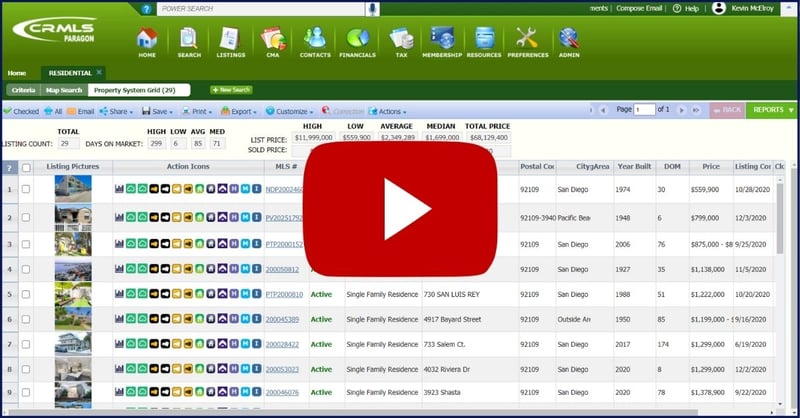
There are four ShowingTime integrations in Paragon:

1. Via Preferences > ShowingTime Setup:
showingTime instruction


2. Under Listing Input and Maintenance:
shwoingtime how-to


3. Via the Action Icon on Spreadsheet and Report Views:
Showing Time Action Icon
4. Via the Action Icon from the Actions Menu on Results:

showingTime

Want to learn how to get started? Visit https://go.crmls.org/showingtime/ for more information.


Topics: CRMLS, Technology, Marketing, PSAR Benefits

PSAR endorsed candidates, propositions were Election Day winners

Posted by Rick Griffin on Nov 9, 2018 12:31:19 PM

PSAR endorsed candidates

PSAR’s Government Affairs Committee endorsed a number of local candidates who were winners in this week’s November 6th general election. Also, PSAR was victorious in positions regarding a local proposition and statewide propositions.

 PSAR endorsed Brian W. Jones who won the seat to represent the State Senate 38th District. With 100 percent of the precincts reporting, Jones drew 56 percent of the vote. Jones, a three-term Republican Assemblyman and current Santee city councilman, succeeded Joel Anderson (R-Alpine), who was termed-out. The massive 38th District, with nearly 1 million residents and covering about 30 percent of San Diego County, stretches from Lemon Grove to Fallbrook, from Borrego Springs to Alpine and includes most of eastern and northern San Diego County. It encompasses eight municipal cities, including Lemon Grove, Santee, La Mesa, El Cajon, Poway, Escondido, San Marcos and San Diego’s Scripps Ranch community, as well as the communities of Lakeside, Ramona and Julian. As an assemblyman, Jones has always been a reliable vote for policies that protect homeownership and private property rights.

PSAR also supported the successful reelection of three city mayors, including Mary Casillas Salas in Chula Vista, Bill Wells in El Cajon and Mark Arapostathis in La Mesa.

Salas won with 70.1 percent of the vote. She has been an elected official since 1996, beginning with the Chula Vista City Council followed by the State Assembly. She became mayor in 2014.

Wells, also an incumbent, won handily with 66 percent of the vote. Elected to the City Council in 2008, Wells has been the city’s mayor since 2013. 

Arapostathis ran unopposed for his mayor’s seat in La Mesa. He was elected as mayor in 2014.

Other PSAR candidates who were successful in their city council races included: John McCann, Chula Vista; Ron Morrison, National City; Gary Kendrick, El Cajon; Bill Baber, La Mesa; Ronn Hall, Laura Koval, Rob McNelis, Santee; Jerry Jones, Lemon Grove.

In a special district race that drew a PSAR endorsement, Dan McMillan was reelected to the Helix Water District board of directors.

PSAR organized a massive campaign to defeat of Measure “W,” a rent control initiative in National City that drew 54 percent of “no” votes. In the city of more than 60,000 residents, about 70 percent of residents are renters. 

National City voters said they did not favor the city government creating new costly bureaucracy  which would limit how property owners manage their rental units . Most econommists agree that the measure would have eliminated incentives for property owners to fix up their units and discourage new housing construction.

PSAR believes rent control reduces the quality and quantity of housing. Typically, rent control leads to reducing available rentals and landlords skimping on repairs. Rent control eliminates incentives for landlords and property owners to fix up, or invest in, their units, as well as discourages new housing construction and decreases the number of available rental units.

In statewide propositions, PSAR agreed with the California Association of REALTORS® (C.A.R.) in its positions on Propositions 1, 5 and 10.

Prop. 1, the Housing Programs and Veterans’ Loans Bond that was supported by C.A.R., passed by a 54.2 percent margin. As a result, the state will borrow up to $4 billion in general obligation bonds for housing-related programs benefiting veterans. The vast majority of the bonds, about $3 billion, will be set aside for various types of housing programs. The biggest share, or $1.5 billion, will go toward the construction and rehabilitation of permanent and transitional rental housing and apartments for California households who earn of up to 60 percent of the area median income. The second biggest portion of the $3 billion, about $150 million, will be earmarked for cities, counties, transit agencies, and developers to build higher density housing near transit stations.

Prop. 5, the Property Tax Transfer Fairness Initiative that was supported by C.A.R., was defeated (42 percent voted “yes,” 58 percent voted “no”). Voters said no to expanding property tax savings for older homeowners. If approved, Prop. 5 would have allowed homeowners over ages 55 to transfer their lower property tax rates with them when moving to a newly bought home anywhere in the state. Prop. 5 was initiated by C.A.R. The measure qualified for the ballot after C.A.R. submitted nearly 1 million voter signatures to the Secretary of State’s office.

Prop. 10, the Local Rent Control Initiative that was opposed by C.A.R., was defeated resoundingly (62 percent voted “no,” 38 percent voted “yes”). C.A.R. opposed Prop. 10 because it would have allowed for the expansion of rent control across California. The initiative would have repealed a 1995 law, the Costa-Hawkins Rental Housing Act, that limits county and city governments’ ability to slow rent hikes. It would have overturned an existing state law blocking cities from imposing rent control on rental units built after 1995 and on all single-family homes and condominiums. Repealing the longstanding Costa-Hawkins Rental Housing Act would have exacerbated the housing crisis, eventually allowing local governments to impose draconian rent control measures. If approved, unelected bureaucrats would have overseen rent control ordinances and determine how much landlords could charge tenants for renting apartments and houses. The election result means those prohibitions remain in place.

The PSAR Government Affairs Committee recommended the endorsements to the PSAR board of directors, which then ratified the recommendation. The Government Affairs Committee is involved in political advocacy and public policy and its impact on homeownership and private property rights.

Topics: Government Affairs